With tree canopies shrinking, invasive plants thriving, and biodiversity on a steady decline, we are always exploring different approaches to habitat restoration. Many invasive plants thrive in the sun so we focus on creating more shade to make invasives easier to manage. Our partners from the Tree Tenders of Upper Darby told us about a faster reforestation technique they had been researching called the Miyawaki method—and we dug in.
Created by Japanese botanist Akira Miyawaki in the 1970s, the approach mimics the soil conditions of old-growth forests to create fast growing miniature native forests. These forests are a mix of canopy trees, understory trees, and shrubs, planted 12 to 18 inches apart. The close spacing provides support and creates competition, which—combined with improved soil conditions—speeds up growth.
The Miyawaki method has gained popularity in Europe and India but has not yet taken off in the U.S. We visited the Horn Farm Center for Agricultural Education in York, PA, to tour their two Miyawaki forests and learn from their experience. The Horn Farm team used broad forks (a tool used in no-till agriculture) to loosen the soil and planted young, bare-root trees by hand. To amend the soil, they spread leaf mulch 4 to 6 inches deep across the entire area.
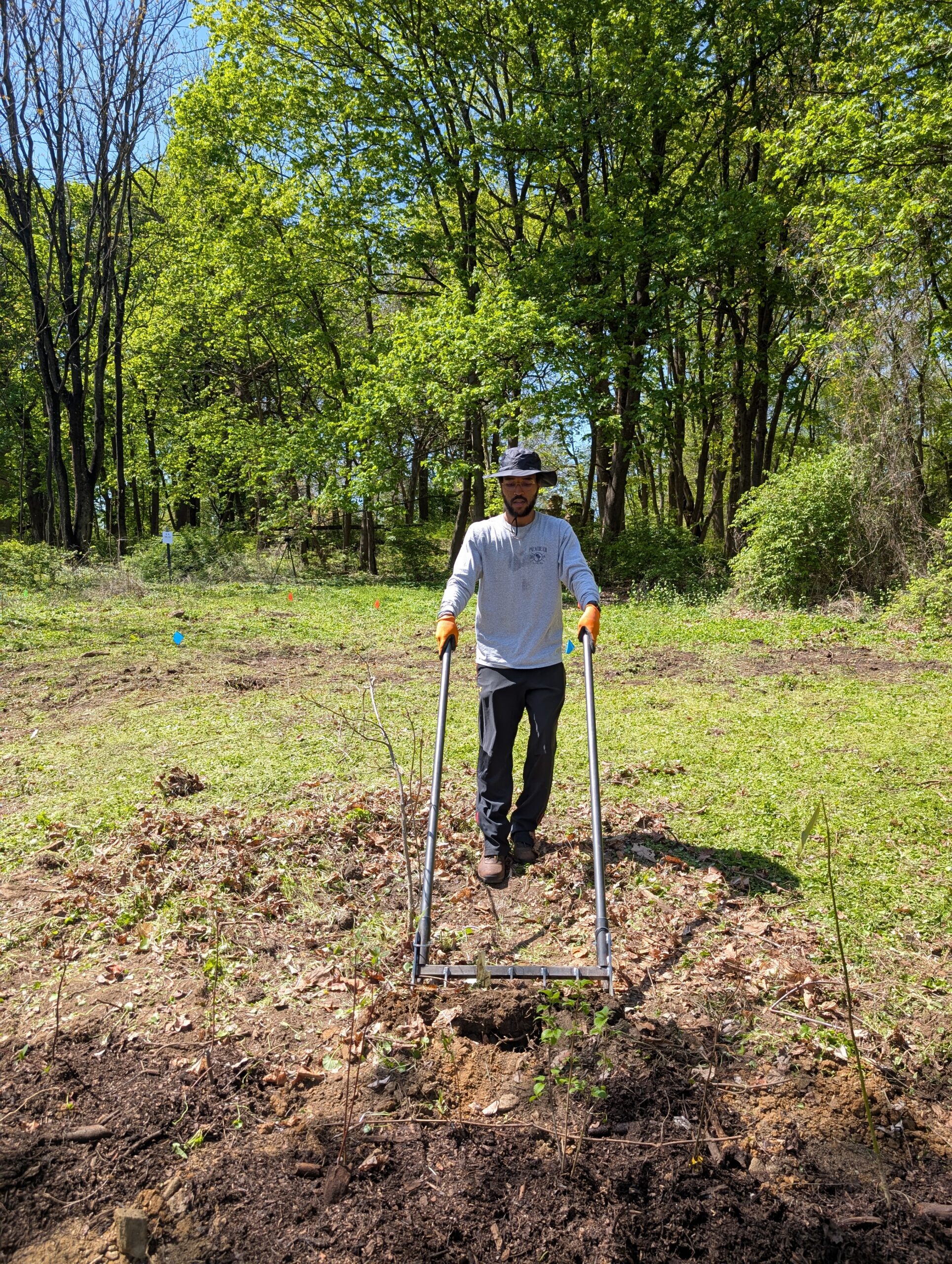
We were impressed by the rapid growth of their forests and inspired by the possibilities, so we started our own Miyawaki native forest in Rolling Hill Park near the cottage in spring 2025. A SHARE grant from Sandy Hollow Arts & Recreation for the Environment, Inc. helped cover the cost of the broad forks, and we sourced as many trees and shrubs as we could to get started.
Our mini-forest broke ground on April 23, 2025 when 165 Friends Central Middle School students came out to Rolling Hill Park for a work day. The students helped with a range of tasks around the cottage and about 25 students and teachers worked on the Miyawaki forest. They loosened the soil with broad forks, pulled out porcelain berry vines, dug up multiflora rose bushes, hauled away rocks, and began planting. After the initial site preparation and planting, we followed up with smaller work days to finish the installation.
We have planted other patches nearby using the Miyawaki method to reforest a field near the cottage that has been overrun by invasive plants. We see this method as a powerful tool in a range of scenarios—forest reconnection, lawn replacement, streamside planting expansion—especially in areas where pressure from invasives makes conventional plantings more difficult to maintain. We will continue to look for opportunities to plant using the Miyawaki method.